

Blue Flag Or Red Flag
This week, how Blue Flag certification for beaches is affecting communities and sensitive systems, and what the data show about school enrolment

Dear Reader
India’s coastline is now estimated to be about 11,100 km, and this includes many pristine beaches. In 2019, the government selected 13 beaches for Blue Flag certification from the Foundation for Environment Education, a Denmark-based NGO. This certification is incumbent on 33 criteria broadly under the categories of environmental education and information, bathing water quality, environment management and conservation, and safety and services.
But this pursuit had led to violation of coastal regulations, some of which are later legitimised through post-facto orders, and to alienation of local communities from public beaches, disrupting their livelihood, we found. Experts warn that these activities are leading to irreversible changes to the sensitive systems.
Elsewhere, four in 10 children are now in private schools, up from about a third seven years ago. Experts say this is largely driven by parental perception of quality of education, and the demand for English-medium instruction. But the shift has not been uniform.
The grey area in blue-flag beaches
After residents approached the National Green Tribunal against illegal constructions in Puducherry’s Eden beach, the panchayat people who had set up temporary stalls. For 58-year-old Anbukarasi and others who earned their living selling food or trinkets on the beach, this has meant loss of livelihood and mounting debt.
Developing beaches to get them the Blue Flag certification has been one of the government’s key eco-tourism initiatives. Between February and July 2026, we visited three beaches—Eden in Puducherry, Kappad in Kerala and Padubidri in Karnataka—to understand the aftermath of the Blue Flag certification that 13 Indian beaches received.
In March 2026, the Puducherry Coastal Zone Management Authority issued a directive to remove unauthorised construction at Eden Beach, including on sand dunes. It ordered removal of the tile work laid down for opening a restaurant and removing unauthorised buildings on sand dunes and restoration of the area. In July, we found that the walls of the restaurant collapsed from erosion while the tile work remained.
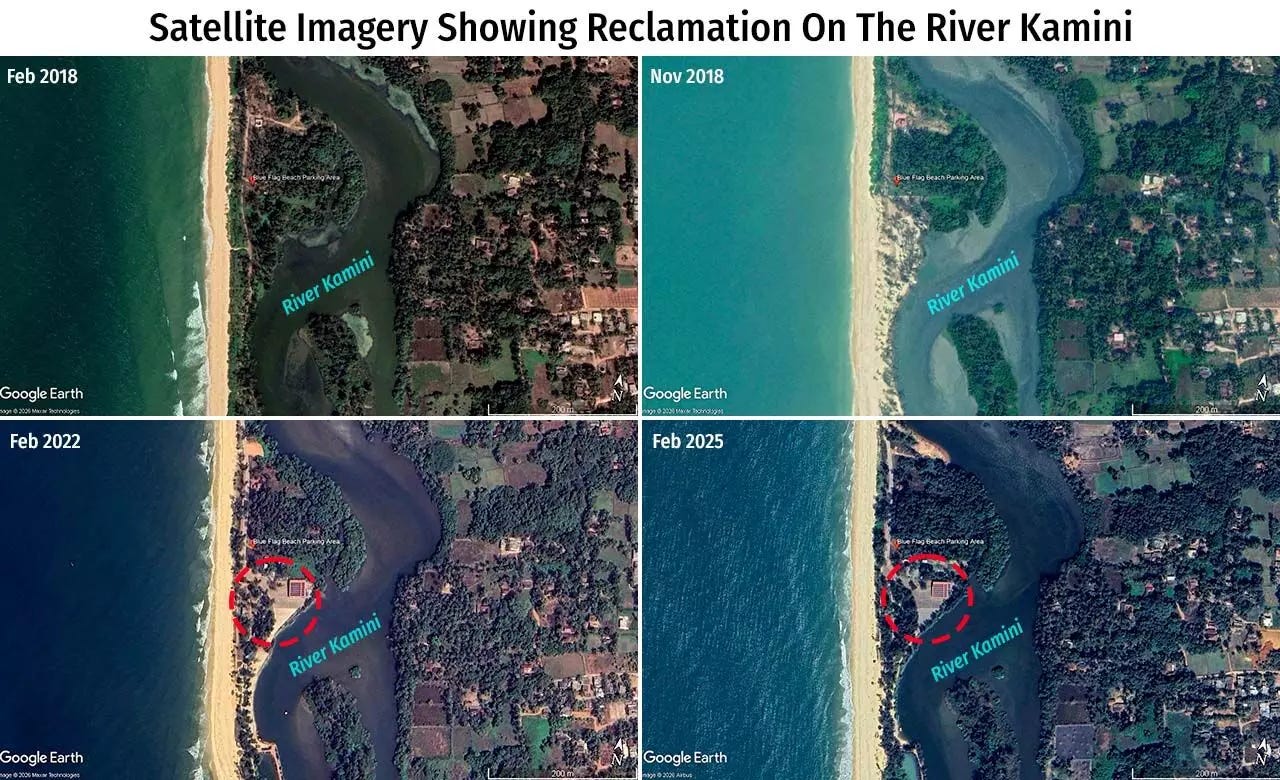
At Padubidri, a green, forested patch along the Kamini river was cleared for a parking lot and treatment plants—reclaiming part of the riverbank in the process.
In Kappad, the infrastructure has corroded and requires constant funds for maintenance. “None of the lights work, the metal structure propping up the solar panels corroded and fell. Those are now lying in a corner as scrap metal,” 64-year-old Nasar Kappad said, adding how none of the permanent infrastructure was made to last.

Both beaches now charge an entry fee, effectively limiting access to local communities. At Kappad, a small stretch outside the certified zone remains free—kept that way, residents say, because children fought to keep their playground.
Shreya Raman writes on the cost of the project.
Why parents prefer private schools
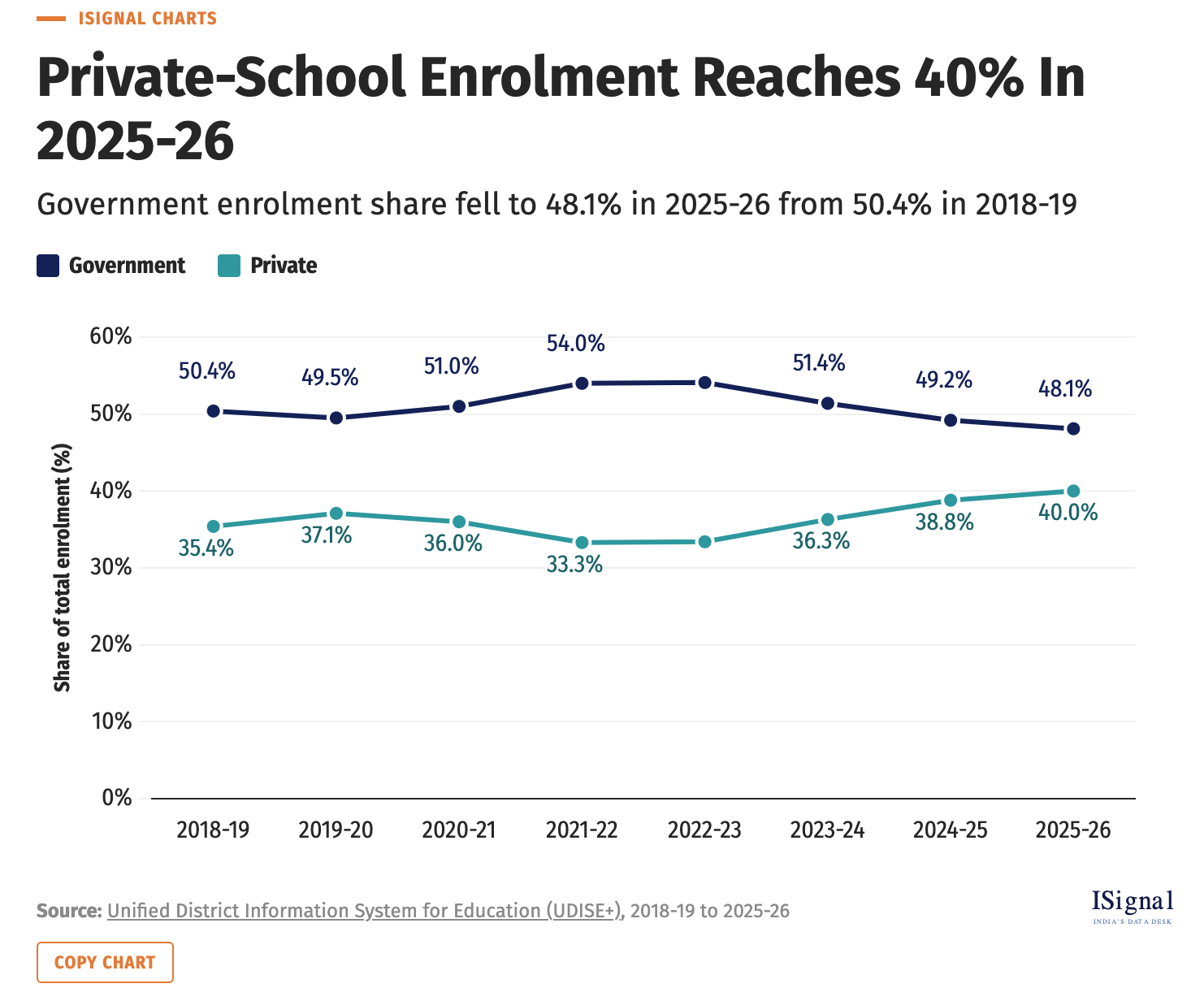
Private-school enrolment increased by about 3 million in the past year, while government schools—where 48% of children are enrolled—saw their numbers decline by about 2.7 million, according to the Unified District Information System for Education (UDISE+).
The number of government schools also declined by 78,500 over this period to reach 1.01 million in 2025-26, with the largest decline (more than 51,000) seen in 2019-20. The private sector, in contrast, saw a net increase of about 15,000 schools, adding up to about 342,000 schools in 2025-26, UDISE+ data show.
Choosing a private school also comes at a higher cost. Average annual education-related expenditure was Rs 28,693 per student in private schools, compared with Rs 2,863 in government schools, as ISignal reported in April 2026.
Bihar and West Bengal have higher government school enrolment, but the trends are different: Bihar's private-school share rose from 10.2% in 2018-19 to 14.8% in 2025-26, while West Bengal's fell from 11.4% to 6.3%.
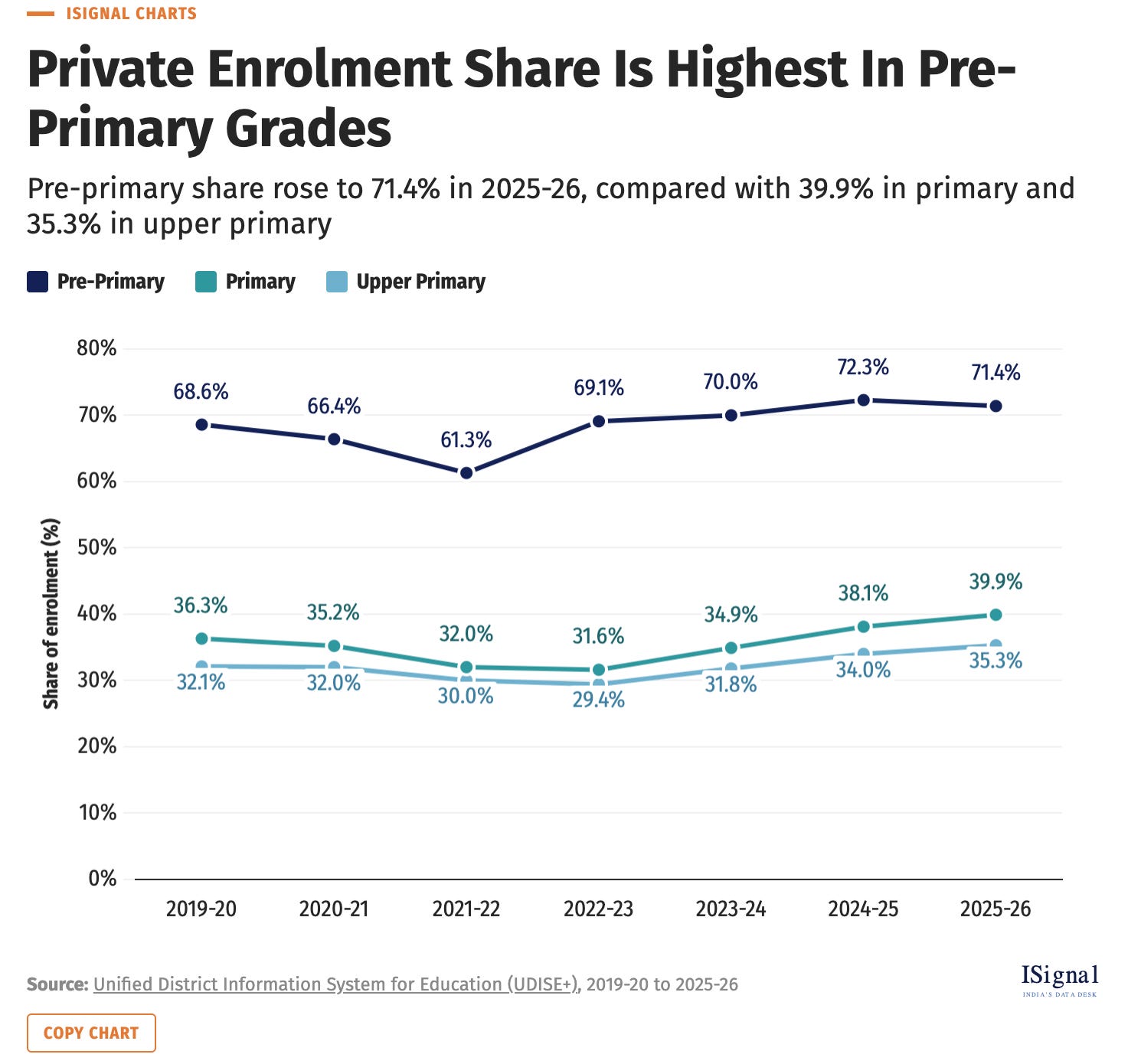
Parents are increasingly choosing private schools at lower levels: 71% students in pre-primary or kindergarten and 40% in primary (grades I to V) were in private schools. In contrast, about 10% of students at the primary level were in government schools.
Among students from marginalised caste groups, enrolment is higher in government schools compared to private institutions.
English medium instruction is also driving the shift to private schools: In government schools, English-medium institutions accounted for 6.4% of schools and 8.3% of enrolment in 2024-25.
Read Vijay Jadhav’s analysis here.
Wish you a happy Independence Day. We’ll be back next week with more.