

Carbon Farming’s Money Question
This week, farmers in private carbon farming projects await returns; and dangerous humid heat is increasing across Indian cities

Dear Reader
Stubble burning—the practice of burning the residue left in the soil after the harvesting of paddy and wheat, before sowing of the next crop begins—releases carbon dioxide and unburnt smoke particles into the air, adding particulate matter pollutants thinner than human hair.
Depending on the location of these fires, wind speed and direction, besides local weather conditions, this contributes to air pollution in places far from the source. Farm fires also impact the soil health and fertility, kill microflora and other organisms in the soil, we explained in December 2022.
Private-owned carbon farming projects, as we noted last week, are enlisting farmers to shift away from this practice and encourage the use of superseeder machines to mix residue back into the soil, offering subsidies on machine rentals upfront. This has also improved soil fertility and yield. But if the climate is unfavourable, farmers say, they have to opt for the faster and more economical method to dispose of this stubble by burning it since there is a short window available to prepare for sowing of the next crop.
For direct-seeded rice, on the other hand, most farmers saw a yield drop. Large landholders say this is offset by reduced spending on labour, but small and marginal farmers are seeing an income drop, which could affect continued adherence to the method.
Elsewhere, we look at dangerous humid heat, which is no longer confined to the hottest months in several Indian cities.
Why farmers need to see the money in carbon farming
Subeg Singh (27) from Saraiyan Kaysthan village in Parsendi block in Sitapur district began using a Rs 2.5-lakh worth superseeder machine even before he enlisted in a carbon farming project. The soil quality for his 30 acres’ land improved and wheat production rose by 2.5 quintals per acre, he told us. For others, the developer is offering an upfront subsidy to offset rental costs of the superseeder.
But another initiative—shifting away from flooded transplanting to paddy to direct-seeded rice, which is aimed at reducing methane emissions—has led to an initial yield drop, farmers told us. For Singh, who did see a small production drop the first year, it still made sense to continue as the overall cost was less, considering his large landholding.
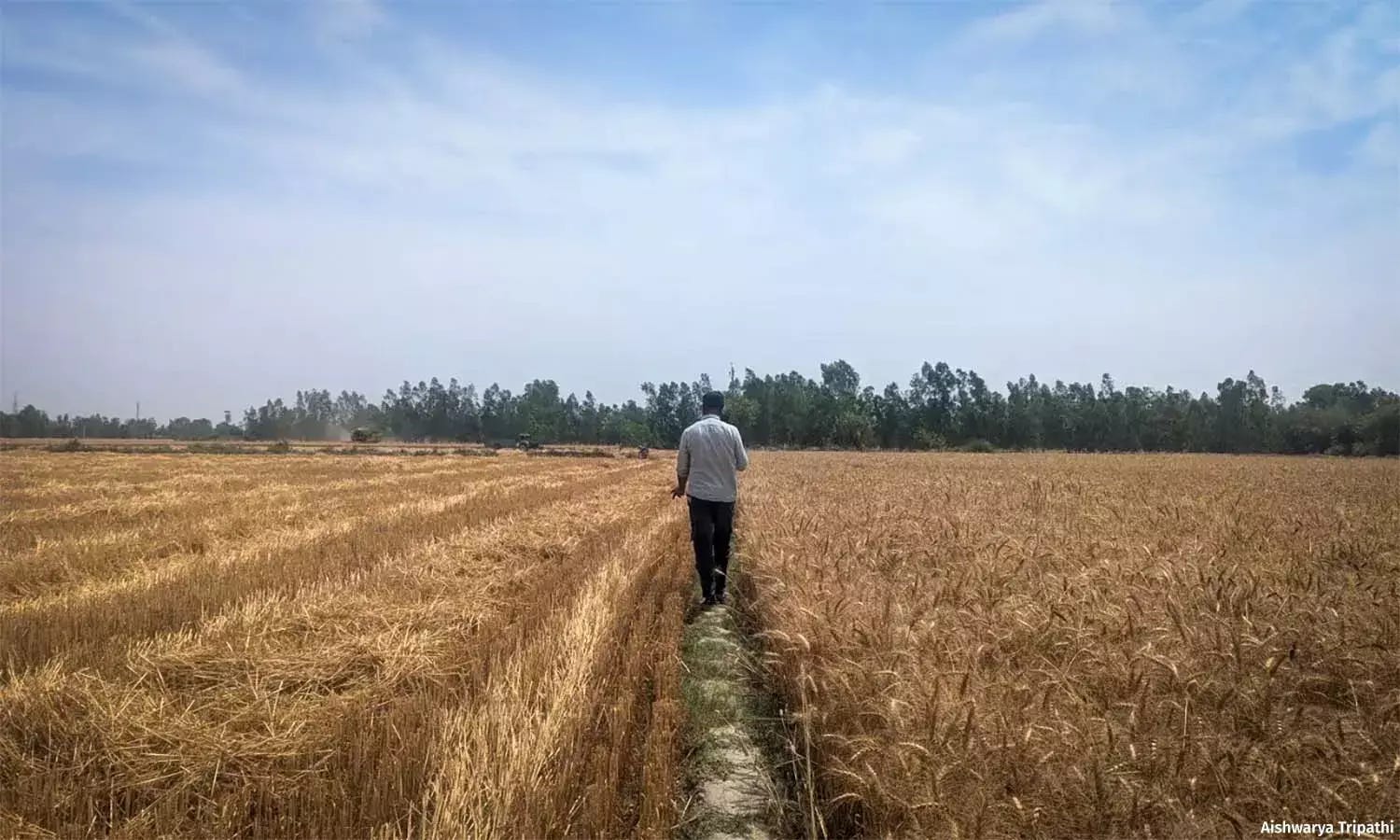
Singh was promised a subsidy of Rs 1,750 an acre for giving up residue burning. In 2025, without explanation he could accept, it dropped to Rs 700. Soil samples are collected every year to measure carbon gains—but farmers say they never see the reports. “They collect samples every year, but there is no word on the reports,” Singh said.
The companies promise 55-70% of eventual carbon credit revenue to farmers—but none can say how much that will actually amount to, since it depends on credit volumes and market prices that remain uncertain.
On the other hand, partners on the ground—farmer producer organisations, mill cooperatives, etc—who are tasked with intensive work such as enlisting farmers, collecting documents, collecting soil samples and helping with monitoring—are often left without answers, potentially affecting the trust built over years.
Experts argue that the long-term success of carbon farming depends not only on reducing emissions but also on creating an ecosystem of training, transparency, technical support and economic incentives that enables farmers to continue these practices. Aishwarya Tripathi writes in the second and concluding part of this series
Humid heat is becoming harder to escape
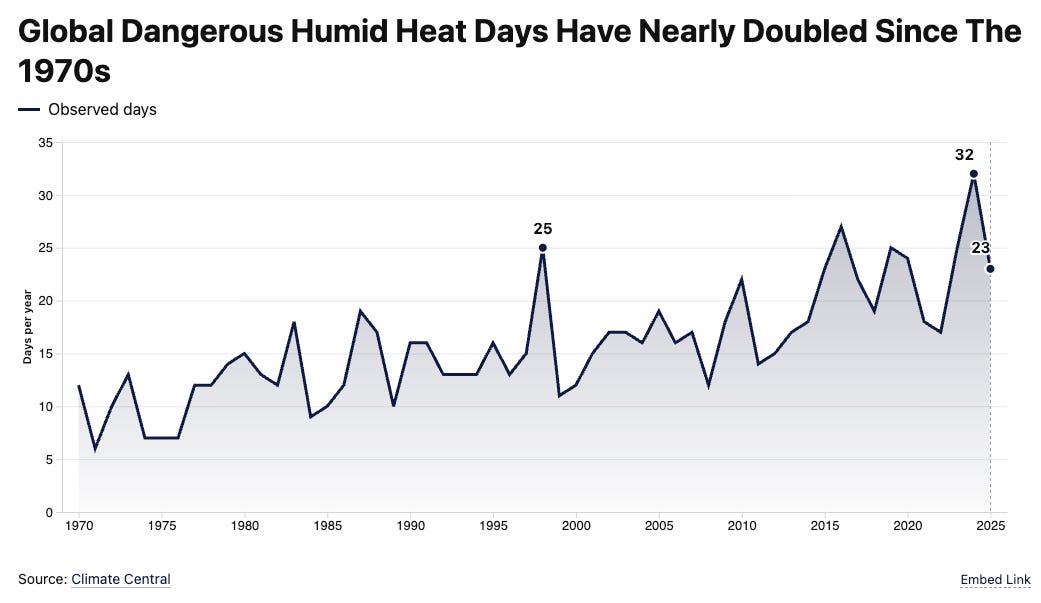
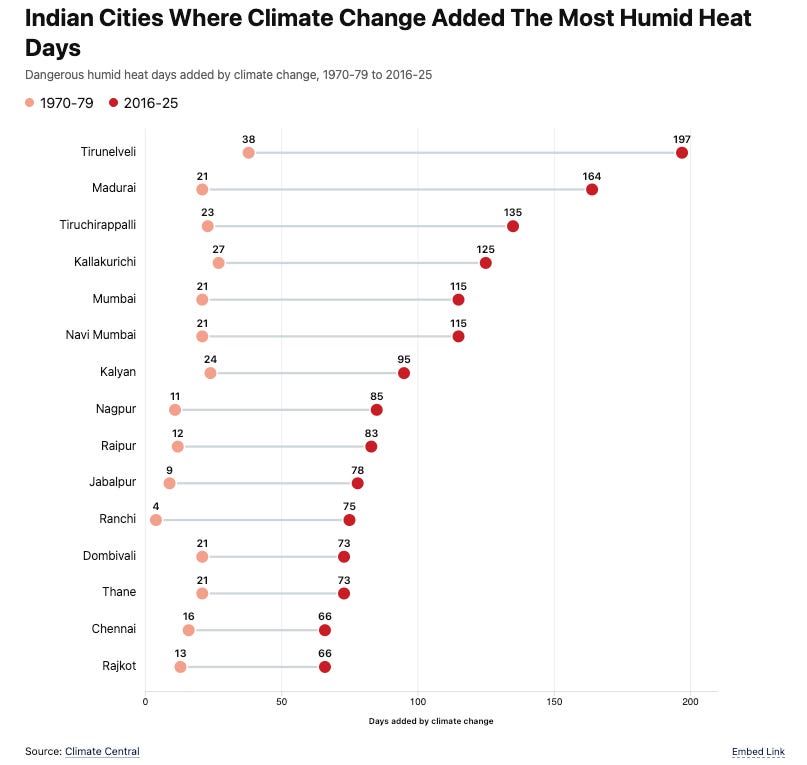
Tirunelveli, Chennai, Tiruchirapalli and Vijayawada now experience more than 250 days of dangerous humid heat every year. That is more than eight months.
The finding comes from Climate Central, which defines dangerous humid heat as days when the maximum wet-bulb temperature reaches 25°C or more. Wet-bulb temperature combines heat and humidity.
Our survival depends on our bodies staying at a consistent temperature, as we explained in August 2017. Normally, our core temperature—from the top of the head to mid-chest, encompassing the brain, lungs and chest—is regulated at 37°C, and our skin at 35°C. Sweating helps us shed excess heat—sweat beads cool the skin, and evaporation of sweat gets rid of heat, restoring the equilibrium.
This process of thermoregulation occurs efficiently only when ambient air is favourable for us. Air can hold a limited quantity of water until it saturates. In dry air without much water content, sweat evaporates quickly, causing cooling. In humid air that has much moisture already, sweat does not evaporate as easily, leading to overheating of the body.
India recorded an average of 141 dangerous humid-heat days a year between 2016 and 2025. Of these, 49 days were attributable to climate change.
In India, heat policy gets split across environment, labour, and health ministries, “and nobody is really coordinating across those”, Vidhya Venugopal, a professor of occupational and environmental health in Chennai, says, adding that India needs heat and humidity rules with real teeth, real-time monitoring, protection schemes for informal workers, and enforcement that means something. Tanvi Deshpande writes.
That’s all for this week. We’ll be back soon, with more.