

How India's Factory Injuries Are Undercounted
This week, how factories routinely flout rules, leading to accidents and injuries, and what a decline in domestic violence cases conceals

Dear Reader
A single factory in Faridabad making automobile components saw 76 workers sustain life-altering injuries between 2018 and 2025, according to a new report released yesterday. This was despite repeatedly being flagged to the government and the auto brands that source material from it.
This one factory represents what’s wrong with the automobile supply chain sector, where workers suffer injuries—many of them ‘crush injuries’ losing two fingers, on average—working on faulty machines, often without formal training, for long hours beyond government stipulations. Two in three injured workers said their factory had been audited in the previous year, but 82% said auditors never spoke to them.
Many of these injuries never make it to government records, and workers face an uphill battle in accessing entitlements. About a fifth of workers and sixth of helpers who were injured said they did not receive a minimum wage. Only 5% received an appointment letter, about half do not receive salary slips, and most of those who do receive them report errors such as underreporting of working hours and lower wages for overtime.
And that’s just a part of the story. These data are based on workers assisted at SII’s Manesar, Faridabad and Gurugram centres in Haryana, and Mohan Nagar and Chakan in Maharashtra.
“SII posits that given its limited outreach nationally, many more thousands of workers continue to be injured in the automotive sector every year across the country,” the report states.
For our other story this week, we look at crime records for the year 2024 to understand the decline in domestic violence cases.
Preventable accidents in India’s factories
In 2025, the Safe in India Foundation assisted 2,514 injured factory workers across India—the highest in a decade. More than two-thirds were in the auto supply chain, working in factories that supply to India’s largest automobile brands.
Most workers who were injured were migrants, young, without formal training, putting in over 60 hours a week. Two in five knew their machines were malfunctioning and many had reported it to their supervisors. They were ignored.
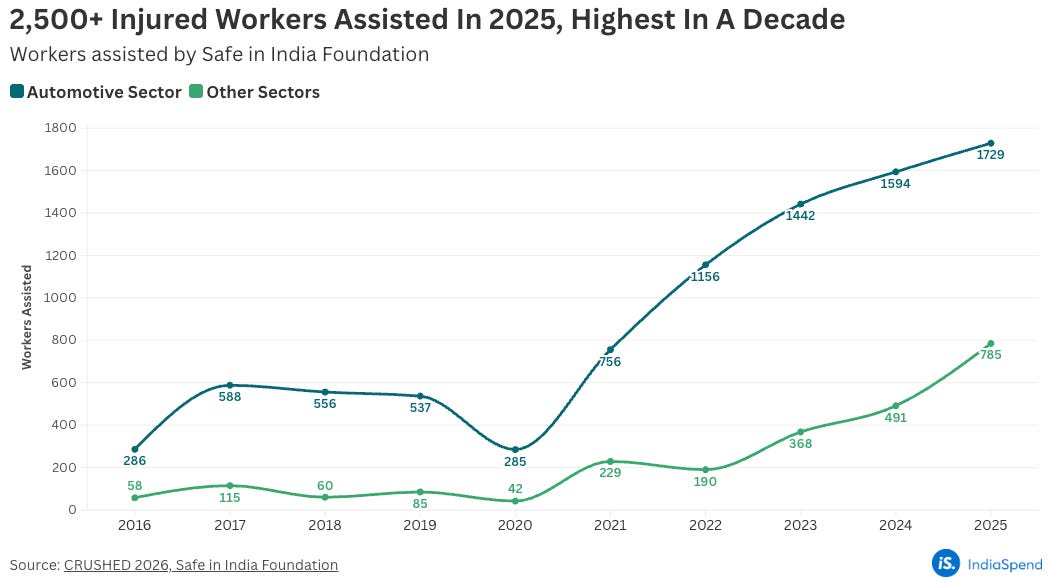
Further, 93% of injuries involved power press machines—used to cut and shape metal—with no safety sensors. “Where sensors do exist, they’re often removed so the machine runs faster, and when workers raise the alarm, they’re ignored,” says Siddharth Raina of SII. “For a factory, the sensor is a small cost; for the worker, the cost is permanent—on average, two fingers lost.”
In Haryana, the Directorate General Factory Advice Service and Labour Institutes recorded 40 non-fatal factory injuries in 2023. That same year, SII assisted 1,041 injured workers in the state.
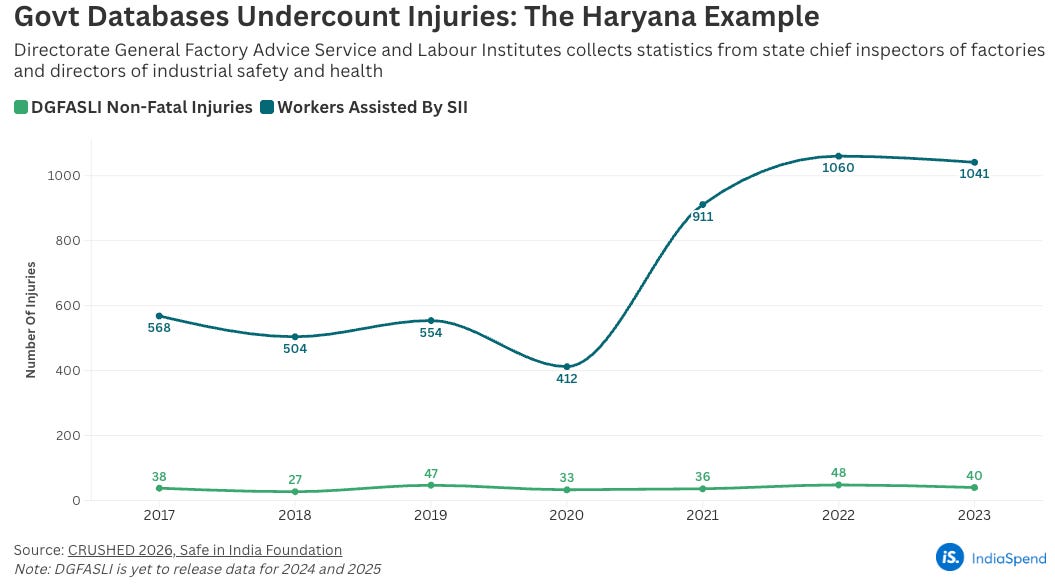
“Both government and buyer inspectors are essentially not reaching these factories, and when they do, they don’t talk to the workers,” says Dhanraj Balakrishna of SII.
What declining domestic violence numbers conceal
Ganga (name changed), 31, starts her day at 6 a.m. She cooks and packs food for her children, drops them at school, and leaves for work. After nine hours, she comes home and cooks dinner. Most nights, her husband beats her. “I don’t think approaching the legal system will solve this,” she says.
Cases under “cruelty by husband or relatives” account for 27% of all crimes against women in India, according to the National Crime Records Bureau’s 2024 report. That year, India recorded, on average, 50 cases of crime against women every hour, down 10% from the previous year.
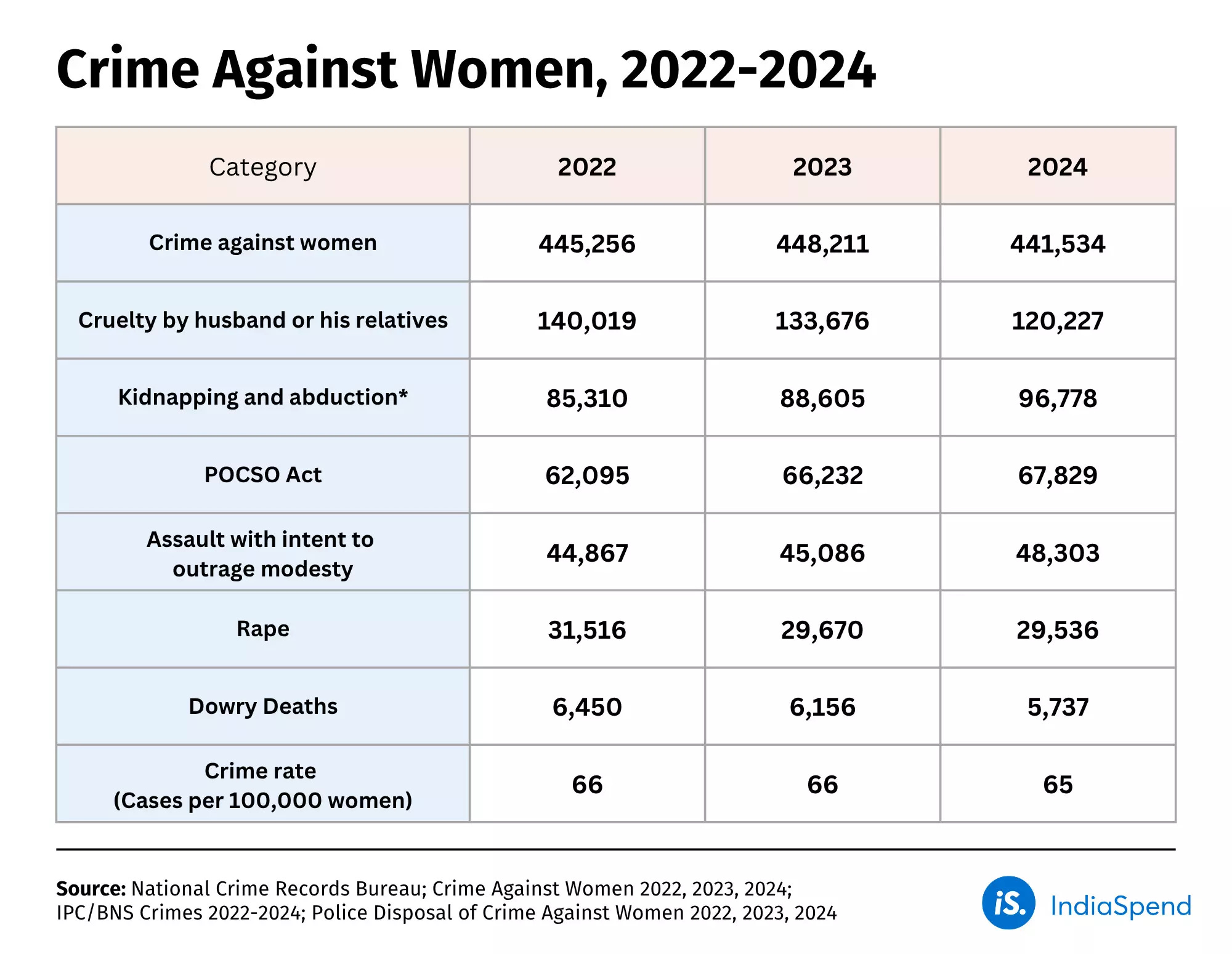
But legal experts say fewer complaints do not mean fewer incidents. “Cases are not reported or escalated, and intervention is not sought till the beating becomes life-threatening,” says Vibhuti Patel, social researcher and activist who has taught at TISS Mumbai. Even when women do come forward, most cases are dismissed as “family affairs” at the complaint stage, before an FIR is registered.
Attitudes help explain the persistence. A 2025 survey across 29 countries found 52% of Indian respondents agreed a wife should always obey her husband. Globally, Gen-Z men hold more traditional views on gender roles than older cohorts.
The National Family Health Survey 2023-24 found that 22% of ever-married women aged 18-49 had experienced spousal physical or sexual violence, down from 29% in 2019-21. Only 14% of women who face such violence ever sought help to stop it.
The legal system, Ganga says, offers little. Her one aspiration: to move out with her husband and children and live as a nuclear family. “I just want to be independent, my children to be educated well, and I want my husband to show some change.”
Saumya Tewari reports on what the numbers conceal and the distance that remains between law and lived experience.