

The Crisis That’s Weighing India Down
This week, why India’s overweight and obesity prevalence is rising, and how India’s existing textile parks are faring

Dear Reader
More than a quarter of Indian men and women are overweight or obese. This is in a country where, as we reported last week, every third Indian child is still underweight. How can this happen together? The answer lies largely in what India eats.
First, India’s diets are cereal-heavy. And as households’ expenditure on cereals has fallen since the turn of the century—partly aided by food security entitlements—that money has not shifted to more nutritious food groups. At the same time, spending on beverages and processed foods has doubled. This also coincides with a 40-fold rise in retail sales of ultra-processed foods.
Second, in the West, lower socio-economic groups are more likely to be obese—a function of lower awareness and access to nutritious food. But in South Asia, as incomes rise, more sedentary jobs and diets high in carbohydrates, edible oils, sweeteners and animal-source foods increase, we had reported in 2019 based on a study published in the journal Nutrients.
“South Asia’s education systems are in effect passive bystanders to the unfolding of a hugely significant nutrition and health crisis; they must do more to inform, educate and promote improved dietary choices, physical activity and healthy behaviours,” said the study.
Elsewhere, as India proposes to set up mega textile parks in challenge mode, we look at the state of existing parks.
The Rise & Rise Of India’s Obesity
A full decade ago, Prime Minister Narendra Modi first raised concerns about India’s rising obesity. After that, he’s mentioned obesity at least 18 times, appealing to his fellow citizens to eat better, calling on sportspersons and teachers to raise awareness, and repeatedly asking Indians to cut down on oil consumption.
Since then, India’s prevalence of overweight or obese—where the body mass index (BMI) is above 25 or 30, respectively—has increased by about 10 percentage points in both men and women.
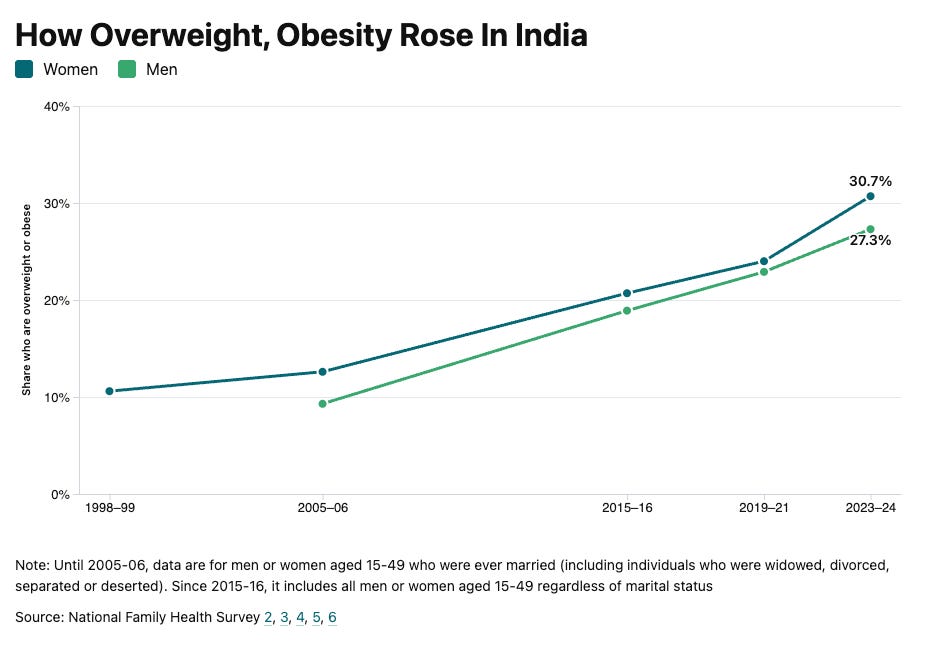
The prevalence is rising across every category in India: rural and urban India, men and women, young and old.
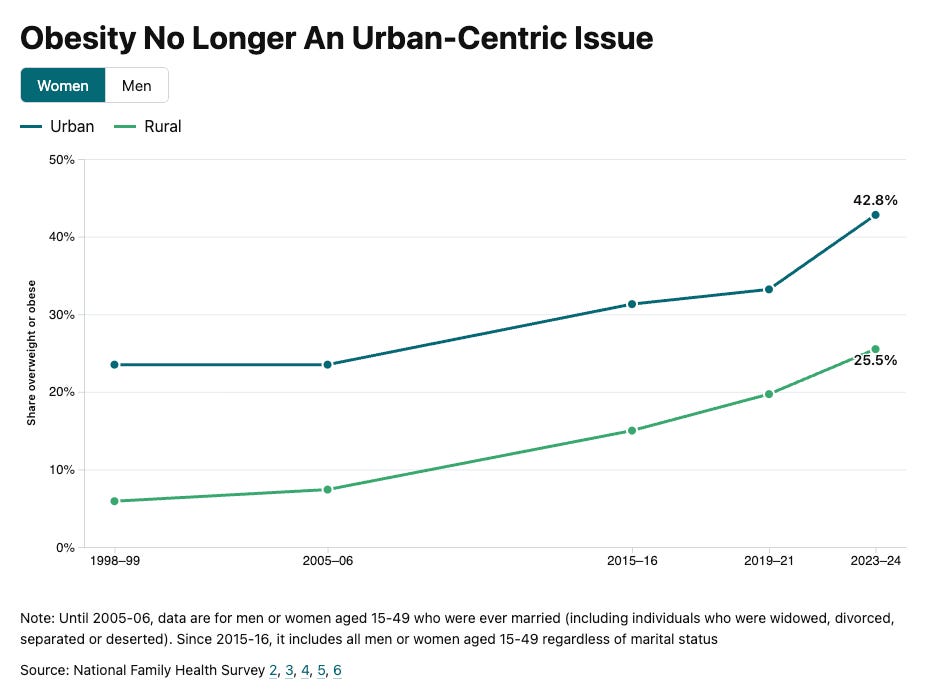
Research shows that the increase is being driven by poor dietary diversity, high consumption of ultra-processed foods, and sedentary lifestyles. Improving diversity in food will help both with undernutrition or malnutrition and obesity or overweight.
Women are carrying a higher share of the burden. “Many women consume the least protein in the household while going through life stages such as pregnancy, where the risk of gestational diabetes increases, and menopause, where declining estrogen levels accelerate muscle loss,” Mrudul Deshpande, a Pune-based functional medicine physician specialising in metabolic health and nutrition, explained.
And that is no surprise. In many Indian households, the men eat first, the children next, and the women last. In 2017, we had reported on an intervention in Rajasthan which got families to eat together, and led to improved nutritional intake for women and children.
Vijay Jadhav analyses data from five rounds of the National Family Health Survey.
Textile Parks Half Empty
Two decades ago, India launched the Scheme for Integrated Textile Parks. Industrial parks aim to cluster manufacturing firms, in the process, helping them to generate efficiencies by accessing common infrastructure.
A 2023 Comptroller & Auditor General (CAG) of India audit found delays of one to more than 10 years in completion of the parks, cancellations of 43% of the sanctioned parks, and generation of 30% of the envisaged employment and 50% of the envisaged investments from the functional units.
The CAG asked why “without ensuring successful completion of the parks sanctioned during the 10th Plan period by March 2007 as envisaged in the Scheme guidelines, the Ministry proceeded with sanctioning more parks in the 11th and 12th Plan periods”.
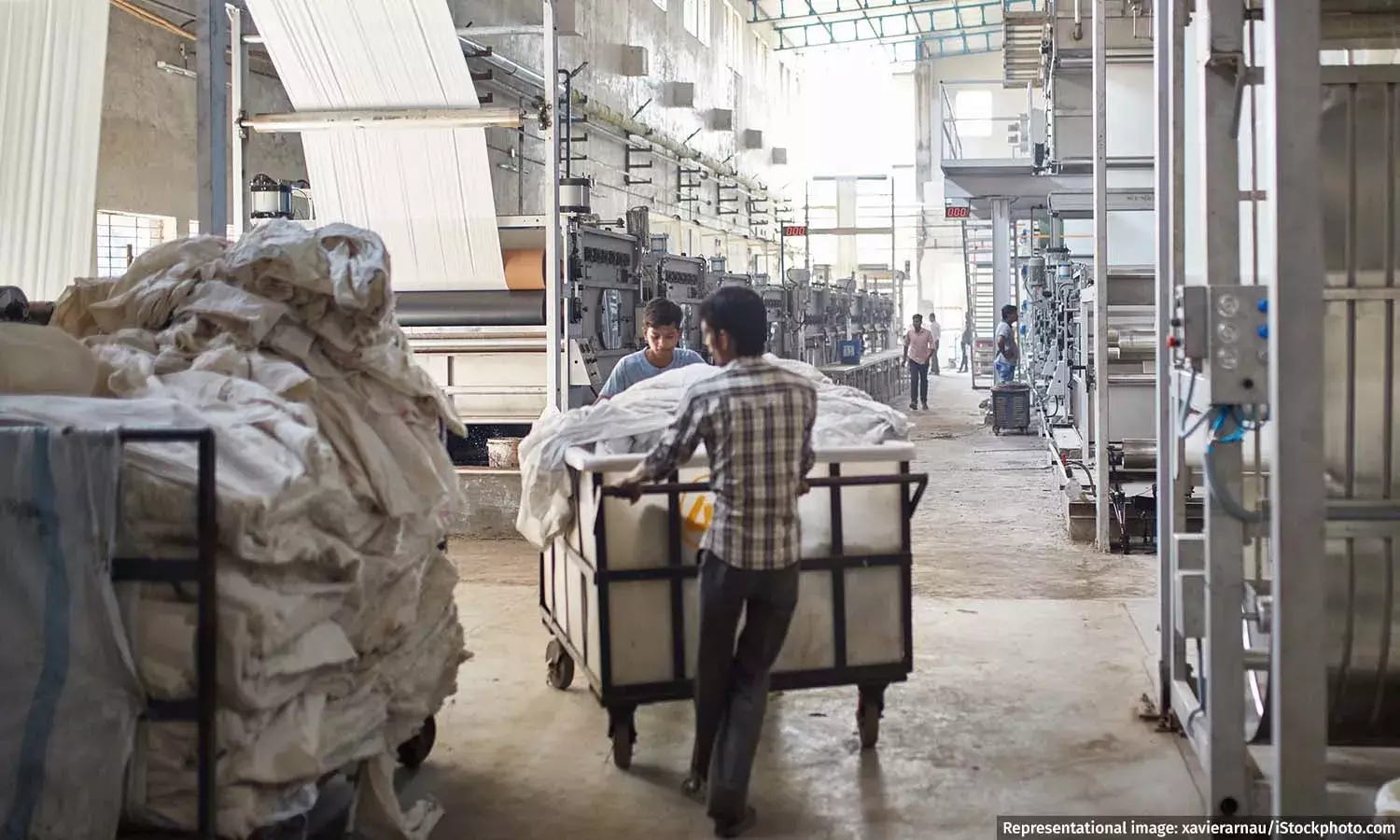
Experts point to the same recurring problems—parks built far from cities where workers and investors don’t want to go, weak marketing efforts, and a lack of anchor investors willing to commit early.
It is not just textile parks that see delays. Of 4,257 industrial parks mapped on the India Industrial Land Bank as of earlier this week spanning 681,000 hectares, 134,000 hectares are still available. Yet, new industrial parks continue to be announced.
India has proposed a new round of mega textile parks—five years after announcing seven of them within a three-year timeline. Most are still under construction. Textiles employ 45 million Indians, the country’s second-largest employer, and contribute 2.3% of GDP.
Read Charu Bahri’s story here.
That’s all for this week. We’ll be back soon, with more.