

The Hazy Picture Of Delhi’s Pollution
Also in this edition, the takeaways for India from COP30, the global climate conference

Dear Reader
A decade ago, when I joined IndiaSpend, we set up #Breathe—a network of low-cost air quality monitors, which at its peak, had 28 stations in Delhi and a total of 110 across 14 cities.
The resulting easy access to realtime data informed the discourse around pollution, with policymakers taking note. This was an era before the ubiquitous AQI or air quality index numbers became popular markers, and before particulate pollution was discussed in detail.
The learnings were several. For instance, we found that:
winter mornings were the worst time of day for outdoor exercise;
the emergency odd-even measure in January of 2016, when half of Delhi’s cars were ordered off the streets, was not enough to reduce the city’s pollution levels; and
that pollution is a year-round problem for many parts of the country.
Several policy measures ensued including a graded action plan for the capital, and a national clean air programme. Yet, year after year, winter months see pollution at dangerous levels and reactive measures do little to help. In this context, our story of the week looks at the gaps in monitoring in Delhi.
Elsewhere, COP30 concluded a mixed bag and we explained the take-aways from the conference.
Few and far between
About two-thirds of Delhi’s area falls outside the purview of an air quality monitor, which means that a large population in the national capital does not know the extent of pollution it faces, according to our spatial analysis. Estimates suggest that Delhi should have at least 52 stations, but there are 38. Even those are unevenly placed.
Areas such as Civil Lines, Chandni Chowk, Mandir Marg, India Gate and Lodhi Road have overlapping monitoring zones, effectively giving them multiple layers of measurement. But farther from the city’s core, the coverage thins out dramatically.
Large parts of outer Delhi—especially Bawana, Chhattarpur, Aya Nagar, Karawal Nagar, Kakrola, Gokalpur, and the rural-urban fringe in the North and Southwest districts—fall almost entirely outside these catchments. These are also the areas where informal industries, brick kilns, waste burning, and traffic from inter-state freight movement converge—making monitoring even more critical.
Similarly, large stretches along the Yamuna floodplains, peri-urban pockets on the eastern edge bordering Ghaziabad, and belts in the northwest between Mundka and Tikri show very low or no direct coverage, despite hosting waste-to-energy plants, industrial godowns, and major highways.
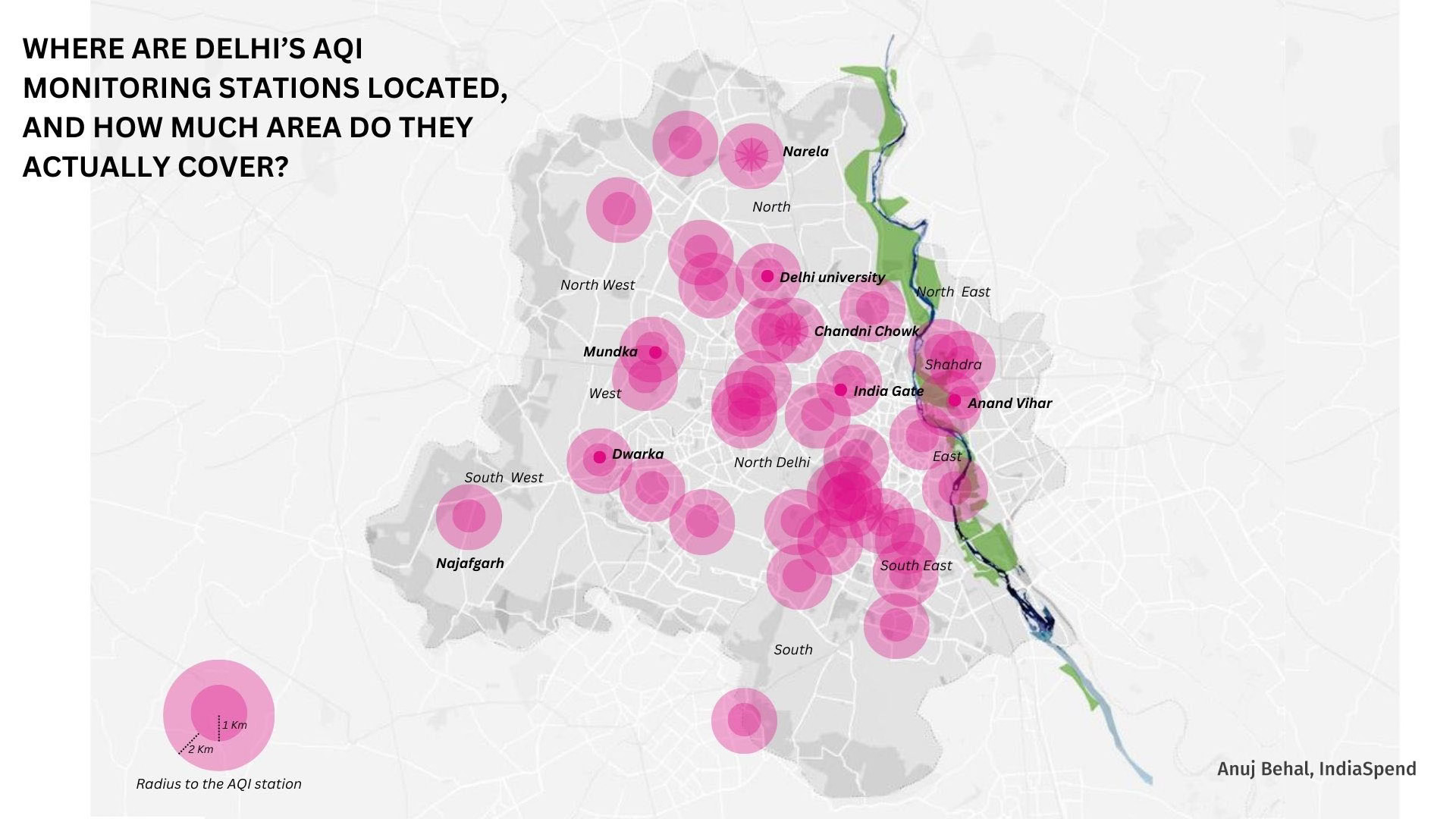
Experts say that a tiered monitoring system—regulatory, reference and local-area planning—will help give an accurate picture of the pollution. The last tier is what Delhi does not have: This means hyperlocal pollution spikes often go unnoticed.
Local monitoring isn’t just about numbers; it makes pollution personal. When residents can see the air they actually breathe, they can take safety measures and demand accountability, Anuj Behal writes.
The Mutirão text
The 30th global climate conference or Conference of Parties (COP30) concluded last week and there are some interesting takeaways. But irrespective of whom you ask—the developed or developing countries—the outcomes in what came to be known as the ‘Mutirão text’ (referring to the Portuguese word for collective effort) fell short of expectations.
First, climate finance commitments were much lower than needed. The 2025 Adaptation Gap Report estimates that developing countries will need between $310 and $365 billion annually by 2035, while current flows are only around $26 billion. Developing countries require about $5.8-5.9 trillion up until 2030 in order to meet their climate goals and comply with what they promised as per the Paris Agreement, as we reported in October 2024.
The final text called for efforts to at least triple adaptation finance by 2035—which, experts say, is vague with no specific accountability of contributors.
Second, while parties sought to impose a binding roadmap for phasing out fossil fuels, developing countries like India and China had argued that developed countries should lead emissions cuts given their historical responsibility. In the end, the matter did not make it to the final text.
Finally, India and like-minded countries argued that “unilateral climate-related trade measures risk becoming instruments of protectionism and undermine multilateral cooperation”, an argument that developed countries opposed. (An example of such a measure is the European Union’s carbon tariffs, which we explain below).
The final text “reaffirms that measures taken to combat climate change, including unilateral ones, should not constitute a means of arbitrary or unjustifiable discrimination or a disguised restriction on international trade”.
Tanvi Deshpande takes stock of the outcomes.
The other tariffs
From January 2026, the European Union’s Carbon Border Adjustment Mechanism (CBAM) will start charging a tariff on six products (including steel and iron imported from India) to plug “carbon leakage”. That is, a fee on imports from countries where emissions on the goods is higher.
CBAM has given the EU the power to recognise and influence climate policy in other countries. It has also used it as a negotiating tool: giving the US—the world’s highest historical emitter of carbon—concessions as part of a trade agreement.
While other developed countries mull about their own versions of CBAM, developing countries oppose such measures. The core of the objections is that it subverts the idea of Just Transition, a framework to help economies become environmentally sustainable but in an equitable manner that doesn’t burden poorer nations.
This flows out of the principle that developed countries—who account for a majority of historic carbon emissions—agree to take the lead in climate action, including financing and transfer of sustainable technologies to poorer countries. Mrinali explains.
That’s all for this week. We’ll be back next week with more stories.