

The Heat Tax On Women Workers
This week, how women lose incomes due to rising heat, and the tyranny of high drug prices

Dear Reader,
I’ve always enjoyed February in Mumbai, from where I am writing this week. This year is no different. It’s easier to walk, the evenings are balmy, and I find myself much more focused and productive. Summers, of course, are oppressive—but for me and nearly everyone reading this email, they affect little more than thermal comfort.
But for millions of Indians working in the informal sector—particularly women—it means poor health, lost incomes, and getting one step closer to poverty. Summers are also when the children are at home, raising costs of food and snacks, and leaving less time and space for women who take up home-based work.
Our story this week looks at the structural issues that makes this happen year after year, and how vulnerability planning does not take that into account.
Speaking of poverty, most families in India are one health event away from financial ruin. And 70% of out-of-pocket health expenditure is on medicines. Why does this happen in a country known as the ‘Pharmacy of the World’, for producing the largest volume of generics and affordable medicines? We explain in the first of a two-part series.
Taken together, these are systemic failures that leave vulnerable populations behind. Both stories expose the same pattern: Infrastructure exists, policies are announced, schemes are launched—but the intended beneficiaries can’t access them.
When Every Degree Costs Money
Last month, we told the story of Anshu Thakur, a tailor in Delhi’s Bakkarwala, who is losing income due to increasing heat. “I am unable to work due to the discomfort I feel inside my home. This is despite having an air cooler and using reflective paint on the roof,” she says.
Thakur used to make Rs 600 a day for six hours of work. Now, she barely makes Rs 200. She is not alone. In 2023, extreme heat cost India an estimated 181 billion potential labour hours—about Rs 13 lakh crore in lost income.
Women bear a disproportionate burden. While they comprise only 23% of India’s informal workforce, 92% of working women are in informal jobs. A 2025 survey by the MS Swaminathan Research Foundation found that 97% of informal women workers reported income losses during peak summer, with average wage losses exceeding Rs 1,500.
For piece-rate workers, the impact is direct: a 20-25% productivity drop from heat means a 20-25% income drop.
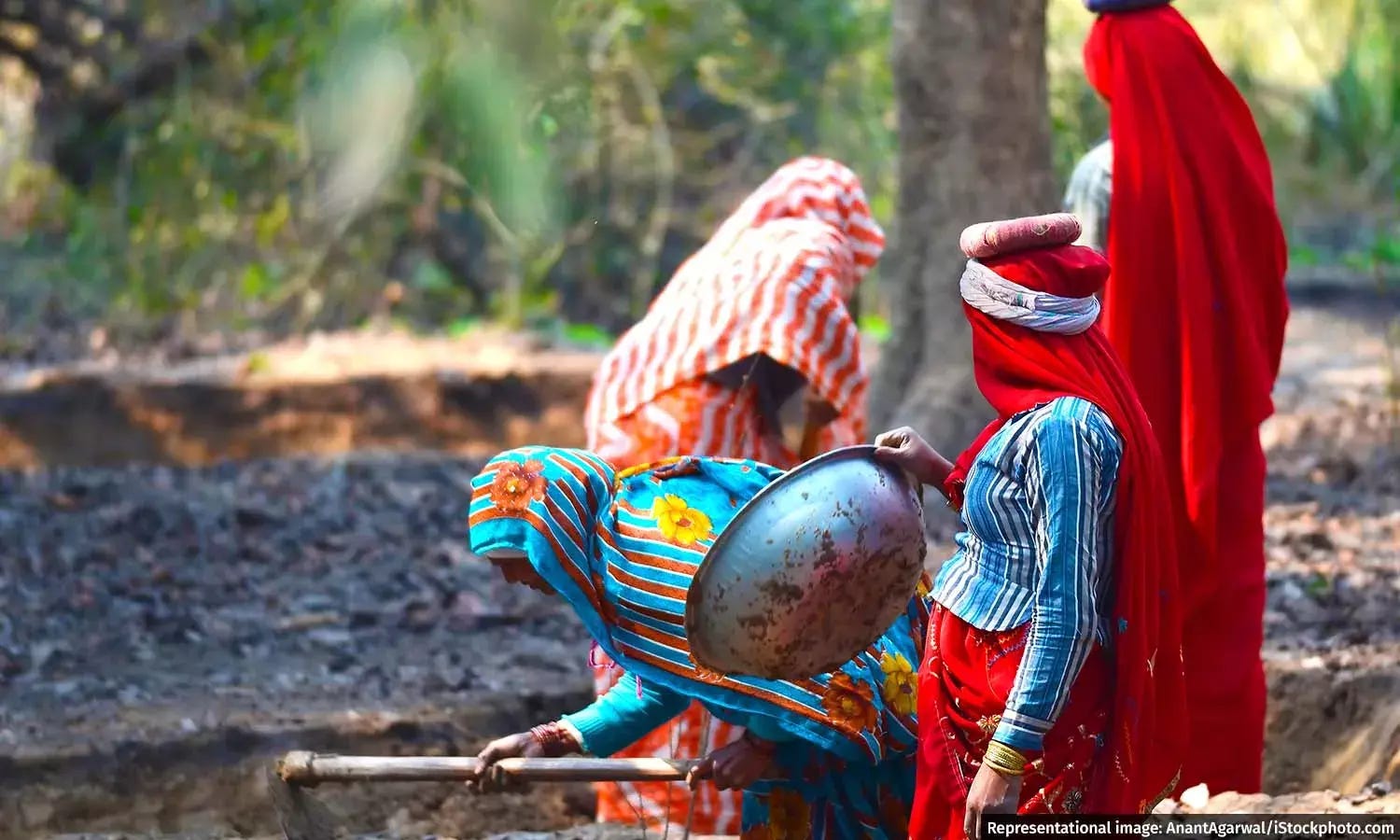
And when heatwaves force women to cut back on paid work, their total workload doesn’t decline. Women spend over five hours daily on unpaid domestic labour and more than two hours on caregiving, compared to just over an hour each for men.
Governments have introduced Heat Action Plans, but a 2024 review of 37 plans across 18 states found that only two conducted vulnerability assessments and only 11 included funding mechanisms. None addressed income loss or provided paid heat leave for informal workers.
“Heat Action Plans focus on preventing illness and death but largely ignore work conditions, income loss and gender-specific risks,” says Vidhya Venugopal, professor at Sri Ramachandra Institute of Higher Education and Research.
Small civil society programmes are trying to fill the gap. In 2024, SEWA’s heat micro-insurance initiative supported about 50,000 women across three states, disbursing nearly Rs 5 crore. But these remain tiny interventions against a crisis affecting millions. Jahnavi Dhanasri writes.
The Pharmacy That Doesn’t Serve Its Own
India is the world’s largest supplier of generic medicines. Yet medicines account for 70% of all out-of-pocket healthcare spending in the country, and between one-third and half of Indian households face catastrophic health expenses.
The Jan Aushadhi stores stock about 2,110 medicines across 17,000 outlets. But doctors aren’t prescribing generic medicines. In August 2023, the National Medical Commission issued a regulation requiring doctors to prescribe drugs using generic names. Three weeks later, the government withdrew it.

Even when generics are available, many don’t trust them. National sampling surveys showed that 10% of unbranded generic samples were ‘Not of Standard Quality’ compared to 3% of branded generics.
“Patients, uninformed about the therapeutic attributes and substitutes for drugs, lack the knowledge and agency to exercise choice,” noted the Competition Commission of India’s 2021 market study.
The National List of Essential Medicines covers only about 384 medicines. Manufacturers can evade price controls by producing unlisted strengths or formulations. Many irrational fixed-dose combinations remain on the market, not subject to price control. Charu Bahri reports in the first of a two-part series. Next week, we will look at the extreme cases—those of drugs for rare diseases.
That’s all for this week. Have a good weekend!