

The Prevention That Isn’t
This week, why HIV prevention medicines are out of reach, and the promise that carbon capture technologies hold for India's path to net-zero

Dear Reader
There’s a particular kind of policy failure that doesn’t announce itself. No scandal, no collapse, no moment of reckoning. Just a guideline sitting in a government document, a technology waiting to be deployed, a pill sitting behind a pharmacy counter that most people who need it have never heard of. Things that exist on paper, and not much else.
This week we have two stories, though they pull in different directions. One is about PrEP — a daily pill that reduces the risk of HIV infection by over 99%, for which India has had official guidelines since 2022. Four years on, government health centres still don’t distribute it, awareness remains low, and access is largely a function of how much money you have and which city you live in.
The other is about carbon capture—a path India has just committed Rs 20,000 crore to developing, at an early but arguably well-timed moment: The science is maturing, costs are falling, and for a country that will be burning coal for decades yet.
The Pill Nobody Talks About
India has had official guidelines for pre-exposure prophylaxis—PrEP, a daily pill that reduces HIV infection risk by over 99%—since 2022. Four years later, government health centres still don’t distribute it.
If you want PrEP today, you’re looking at Rs 2,200 to Rs 3,000 a month out of pocket, or you need to live close to one of the handful of NGOs offering it at subsidised rates in select cities.
This matters because India’s HIV numbers have plateaued. New infections have not fallen in years. And the populations most at risk—men who have sex with men, transgender persons, people who inject drugs, female sex workers—have HIV incidence rates many times higher than the national average. Among people who inject drugs, incidence runs at 34 per 1,000 uninfected people. The national average is 0.05.

The picture gets more complicated with chemsex—the use of stimulants like crystal meth during sex, rising among queer and transgender communities. Standard drug intervention programmes focus on opioids; They’re not designed for stimulants or the private, hookup-app-based networks through which chemsex travels.
PrEP could provide real protection here, but only if people know it exists. Most don’t. A multi-city survey found that only 6–8% of high-risk groups had even heard of PrEP—but once told about it, over half said they’d use it if subsidised.
The irony is that injectable PrEP, approved by the US FDA last year and recommended by the WHO, is now licensed to generic manufacturers including India’s own Dr Reddy’s. At an estimated $40 for a full year—cheaper than the current monthly pill—it could reach more people. Manu Moudgil reports from New Delhi.
Carbon Capture’s Long Bet
India has committed to net zero by 2070. Getting there will require some combination of renewable energy, efficiency gains—and according to the government’s own modelling, capturing roughly 11.4 billion tonnes of CO₂ from industrial sectors over the coming decades. Last month’s Union budget allocated Rs 20,000 crore to Carbon Capture, Utilisation and Storage over five years.
The technology is early-stage everywhere, not just in India. Globally, CCUS currently captures only 0.1% of total emissions. The government’s own December 2025 roadmap is candid that India can currently mitigate a “negligible amount” through CCUS.

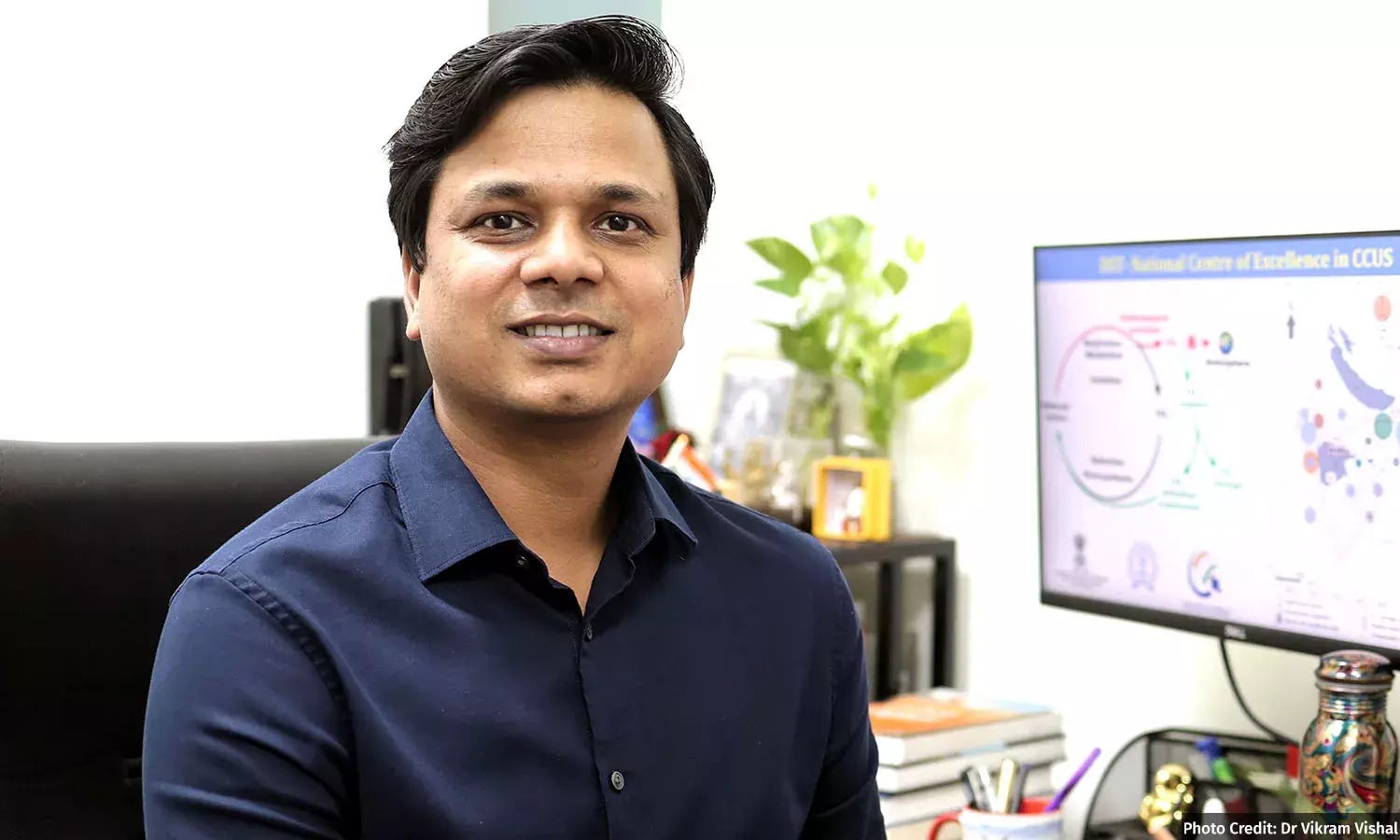
Vikram Vishal, who runs the National Centre of Excellence in CCUS at IIT Bombay, is building it. His team recently completed India’s first test wells for geological CO₂ storage—drilling into sedimentary rock to understand whether captured carbon can be buried underground safely. An atlas of coal fields suggests India could store 395 to 614 billion tonnes in the subsurface. The next step is a pilot injection test.
The challenges are well understood: high upfront costs, an energy penalty in the capture process, and the need to retrofit existing industrial infrastructure. Critics argue CCUS gives countries an excuse to keep burning fossil fuels.
Vishal doesn’t entirely disagree with the concern, but holds the line on the underlying logic. Eighty percent of global energy still comes from fossil fuels. Steel and cement emit CO₂ as an inherent part of their chemistry—renewables can’t simply substitute for that. And costs do come down: direct air capture has dropped from over $2,000 per tonne to under $300 as the technology has matured.
The Rs 20,000 crore allocation is a signal that India is serious about developing this capability. Whether that’s enough, and whether it arrives in time, is the question the next five years will answer. Read more in this interview with Tanvi Deshpande.
Have a good weekend!