

What NFHS Tells Us About Mothers & Children
Indian children still have low weights, and deliveries by Caesarean section are rising, particularly in the private sector

Dear Reader
Every three years or so, the National Family Health Survey gives us a detailed snapshot of health across India—based on interviews with hundreds of thousands of households.
The sixth round released this year covers over 680,000 households that form a representative sample of the national picture, and includes four schedules:
the household schedule, with information such as access to electricity, drinking water, insurance coverage, etc.;
the woman’s schedule, which includes indicators on marriage, fertility, contraception, child immunisation, and domestic violence etc.;
the man’s schedule, which covers information such health issues, nutrition, sexual behaviour and attitudes towards gender role; and
the biomarker schedule, which includes measurements of length/height and weigh, blood pressure and random glucose levels.
Earlier rounds also included data such as infant and early childhood mortality, but even without these indicators, the latest survey conducted during 2023-24 provides a wide picture of population health and healthcare trends. This week, we parsed NFHS data to understand the state of children’s health and delivery care.
First, the good news: Indian children are now taller than before, with data showing a decline in stunting rates. Stunting is an important proxy for overall cognitive and physical development, and studies have shown that stunted children face a lifetime of lost opportunities in education and work.
Elsewhere, births by Caesarean section have increased to 17% in public facilities, which indicates an improvement in emergency obstetric care.
But, children continue to have lower weights, and more than half the deliveries in private hospitals across India are through C-sections, we found.
Why Every Third Indian Child Is Still Underweight
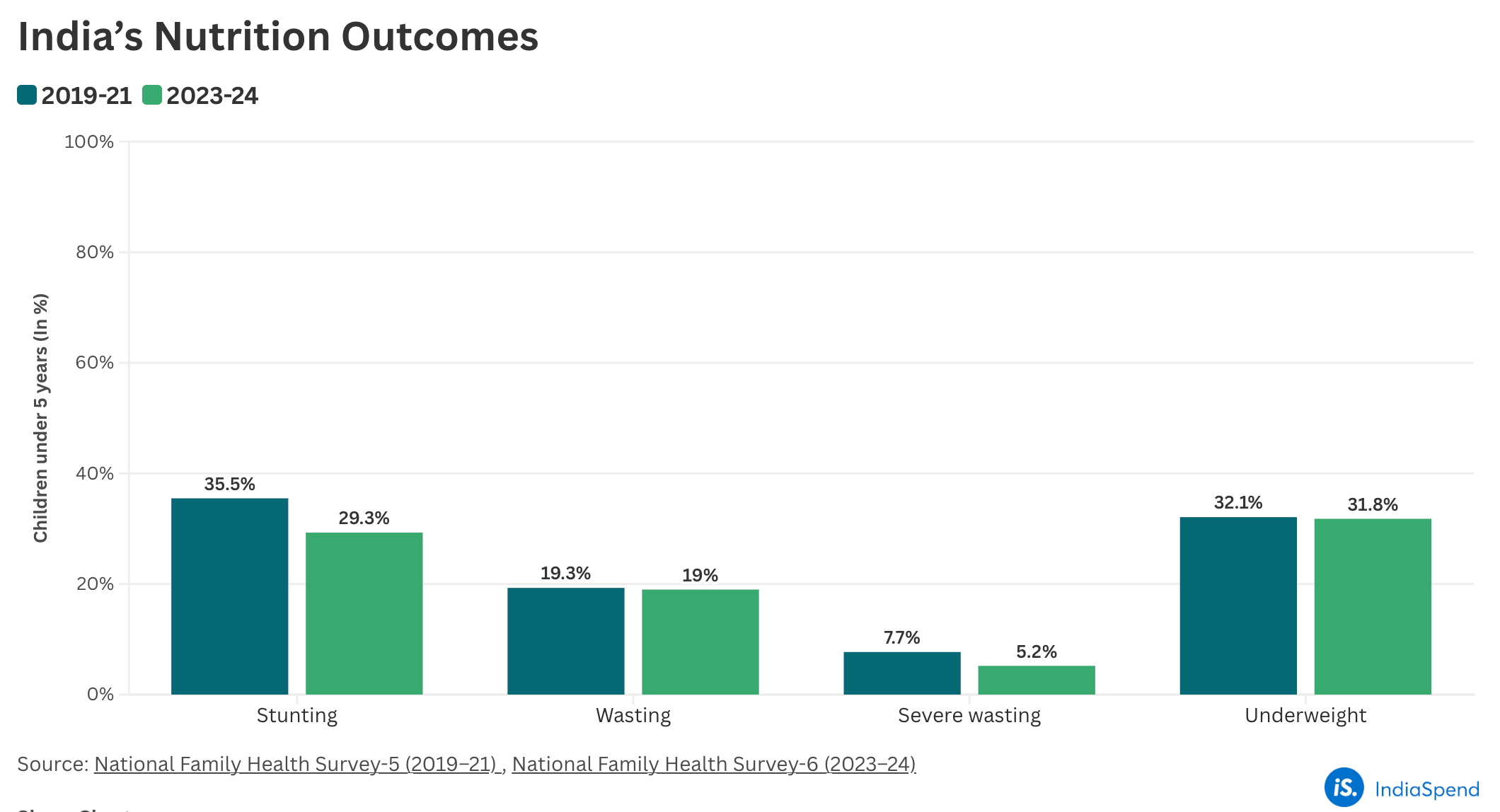
Indian children are growing taller. Stunting fell from 35.5% to 29.3% between the two survey rounds. But nearly two in five children are still wasted (low weight for height), and a third remain underweight.
Some of the improvement in stunting traces back to better maternal care: antenatal visits rose from 59% to 65%, and immunisation coverage climbed from 77% to 83%. Early breastfeeding also improved sharply, up from 41.8% to 50.1%.
But exclusive breastfeeding for infants under six months actually fell, from 64% to 56%. And only 15% of children aged 6–23 months get what the survey calls an “adequate die”.
“Weight is such an important thing,” said Veena Shatrugna, former deputy director of the National Institute of Nutrition (NIN) and advisor to Jan Swasthya Abhiyan (JSA). “If children are growing taller but not putting on weight proportionately, then underweight and wasting remain concerns.”
Nutrition experts have long argued that dietary diversity depends not only on awareness and feeding practices, but also on whether families can regularly afford foods such as milk, pulses, fruits, vegetables and animal-source foods. “How can you improve dietary variety without improving incomes?” asks Shatrugna.
Overall, food accounts for about 46% of monthly spending, data from the Household Consumption Expenditure Survey show. But while the share of cereals fell from 22% at the turn of the century to about 5% in 2022-23, other food groups have not seen increased spending.
Prachi Salve reports on the gap between height gains and weight stagnation, and why India needs to move from food security to nutrition security.
Why C-Section Deliveries Are Rising in India
More than a quarter of Indian births now happen via C-section, up from 21.5% in 2019-21. The WHO recommends Robson classification, a checklist of 10 obstetric parameters, to determine the need for a C-section. These include factors such as the history of a pregnancy and gestational age.
Some of the increase is good news, considering that the profile of pregnant women has changed significantly over the past two decades. Women are having children later in life, fertility treatments such as IVF have become more common, and conditions such as obesity, diabetes, hypertension and other pregnancy-related complications are increasing. In this context, higher rates show improved access to emergency obstetric care.
But a 2015 WHO statement says C-section rates above 10% do not reduce maternal or newborn mortality at the population level. In public hospitals, the rate sits close to the WHO’s recommended threshold, at 17%. In private hospitals, it is 54%. “What we are seeing now is that three out of every five Caesarean sections in India’s private sector are medically unnecessary,” says Abhay Shukla of Jan Swasthya Abhiyan.
A normal delivery can take twelve hours of monitoring; a C-section is scheduled and quick. And the costs fall on families—private delivery costs 17 times more than public care, and states with high C-section rates also have among the highest delivery costs, data show.
Financial incentives may further explain the increase. Dileep Mavalankar, former director of the Indian Institute of Public Health, Gandhinagar, argued that payment systems often reward C-sections more than normal deliveries, creating incentives that favour surgery. Referring to earlier experiments in Gujarat, he noted that when private hospitals were paid a fixed amount regardless of whether a woman delivered vaginally or by C-section, surgical delivery rates remained comparatively low.
Read Prachi Salve’s analysis here.
Have a good weekend.