

Where Jail Is The Rule
This week, how undertrial prisoners languish without trial, and how a Mumbai landfill made it to an infamous list

Dear Reader
About 9,000 people arrested before the Covid-19 pandemic remained in Indian prisons at the end of 2024, with their trials still pending. Another 20,000 people had spent between three and five years in custody waiting for their trial.
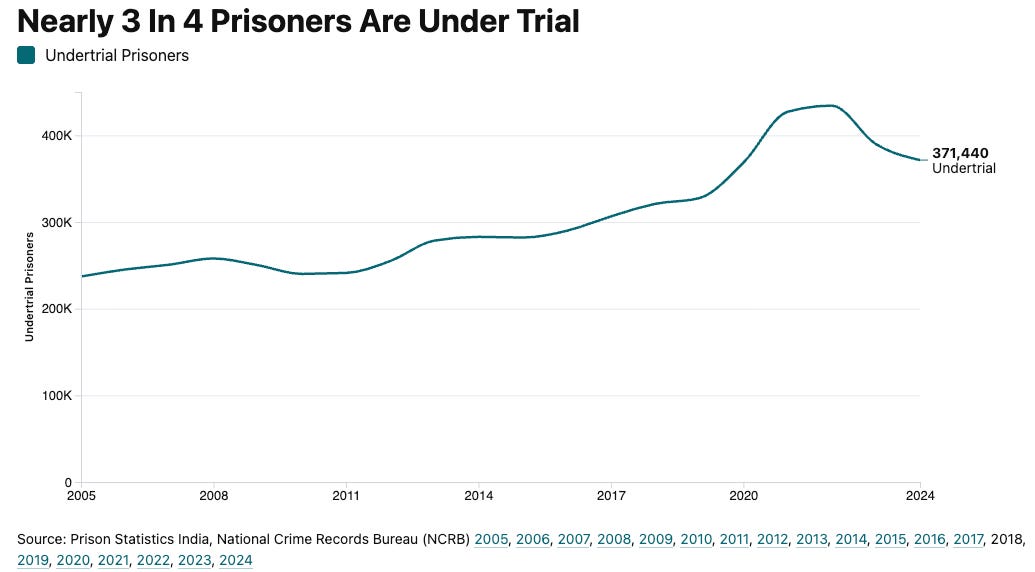
Overall, India’s 1,333 prisons held over half a million inmates. Of these, 371,000 were under trial. Only eight other countries have a higher proportion of prisoners in pre-trial detention.
This week, we looked at the state of Indian prisons using latest data from the National Crime Records Bureau.
Undertrial prisoners are typically young, with low levels of education, and a majority are from marginalised communities. The reason for this profile, we had reported over the years, is indiscriminate arrests, limited access to legal assistance and difficulties in meeting bail conditions.
Elsewhere, Mumbai’s Kanjurmarg landfill made it to the list of 25 sites with the highest emissions of methane across the world. We explain how the trouble begins with a lack of waste segregation at source.
Who are India’s undertrial prisoners?
India’s prisons held 511,000 people at the end of 2024—13% above capacity. In addition, about 1.5 million undertrials were released on bail that year, indicating the constant overcrowding in jails.
Nearly three in four were undertrials: people in custody whose cases are still pending investigation or trial. Their share has risen from 66% in 2005 to 73%.
Two in three undertrial prisoners belong to Scheduled Caste, Scheduled Tribe or Other Backward Classes communities. Another 26% are Muslim, Sikh or Christian.
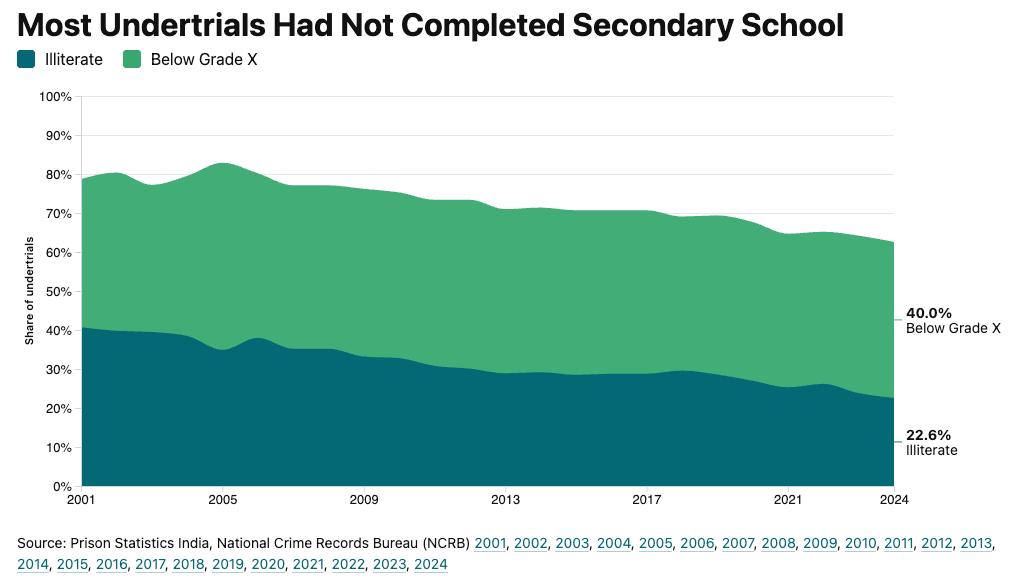
Nearly half are under 30. About 63% did not complete secondary school.
“When young undertrials are from poor socio-economic and educational backgrounds, their life chances get reduced,” Vijay Raghavan, professor at TISS’s Centre for Criminology and Justice, told us earlier. “Longer periods of imprisonment can affect their health including mental health.”
A provision under the Bharatiya Nagarik Suraksha Sanhita allows first-time offenders to seek bail after serving a third of the maximum potential sentence. In 2024, 968 undertrials were identified for release under these provisions, and 627 were released.
How Mumbai’s garbage is contributing to global warming
Mumbai’s Kanjurmarg landfill—which receives most of the city’s waste—ranked 12th in a global list of 25 sites with the highest methane emissions from the waste sector. Methane’s warming impact is 28 times more potent than carbon dioxide. It is responsible for about a quarter of global warming. India ranks sixth among the world’s largest methane emitters.
Last year, the landfill in suburban Mumbai emitted 4.9 tonnes of methane per hour, on average. This is roughly equivalent to the warming impact of one million SUVs. For context, greater Mumbai has a total of 1.5 million cars.
The trouble begins before waste reaches the landfill. Mumbai generates around 6,300 tonnes of solid waste a day, of which 72% is food waste. Wet and dry waste are rarely separated at source, meaning biodegradable material that should be composted or processed ends up decomposing in landfills and releasing methane.
“The law clearly states municipal bodies will not collect mixed waste but segregation is neither being done nor is being enforced,” said activist Rishi Agarwal, who has worked on Mumbai’s waste crisis for over 30 years. Residents near Kanjurmarg continue to report foul odour, mosquito infestation and health hazards. The Bombay High Court has threatened to order the facility’s closure if urgent steps are not taken.
Read Tanvi Deshpande’s story here.
Have a good weekend.